
Critical illness insurance in Canada pays a one-time, tax-free lump sum directly to you if you are diagnosed with a covered condition and survive the required waiting period. It does not replace your income month by month the way disability insurance does. It does not pay your beneficiaries after you die the way life insurance does. It gives you a single, large payment at the moment a serious diagnosis arrives, when your family needs financial breathing room the most, and lets you use it for anything at all.
Article summary
This is Article 1 of a seven-part series on critical illness insurance in Canada. It introduces what the product is, how it works, and why it belongs in a complete family protection plan alongside life and disability coverage. Later articles cover covered conditions, needs analysis for families, children’s coverage, coverage for the self-employed and business owners, structuring decisions, and how CI, disability, and life insurance work together.
The Canadian insurance market has three core personal protection products: life insurance, disability insurance, and critical illness insurance. Most Canadian families understand the first two in at least general terms. Life insurance pays when you die. Disability insurance pays when you cannot work. Critical illness insurance sits between them, and it fills a gap that neither of the others was designed to close.
This article explains what critical illness insurance in Canada actually is, how the benefit works mechanically, what triggers a payment, and why the financial reality of surviving a serious illness is different from, and in some ways more immediately disruptive than, either dying or becoming disabled in the traditional sense.
What is critical illness insurance in Canada
Critical illness insurance in Canada is a type of living benefit that pays a one-time, tax-free lump sum if you are diagnosed with a covered serious illness and survive for the required period, typically 30 days after diagnosis. The payment goes directly to you, not to a healthcare provider or a beneficiary, and you can use it for any purpose. Most Canadian policies cover between 3 and 26 conditions, with cancer, heart attack, and stroke accounting for the large majority of claims.
The term “living benefit” is meaningful here. Unlike a life insurance death benefit, which pays after you are gone, critical illness insurance delivers its payment while you are alive and dealing with the diagnosis. Unlike disability insurance, which pays a monthly benefit tied to your inability to work, a CI payment is not income-tested, not tied to your employment status, and does not stop when you return to work. It is a single, unconditional payment whose only conditions are the diagnosis itself and survival of the waiting period.
According to the Canada Life guide to critical illness insurance, the payment can be used to help cover lost income, out-of-pocket medical expenses, home care, childcare, or any other cost the illness creates. The unconditional nature of how the benefit can be spent is one of its most important features: you do not need to justify to anyone how you use the money.
The three statistics every Canadian family needs to know
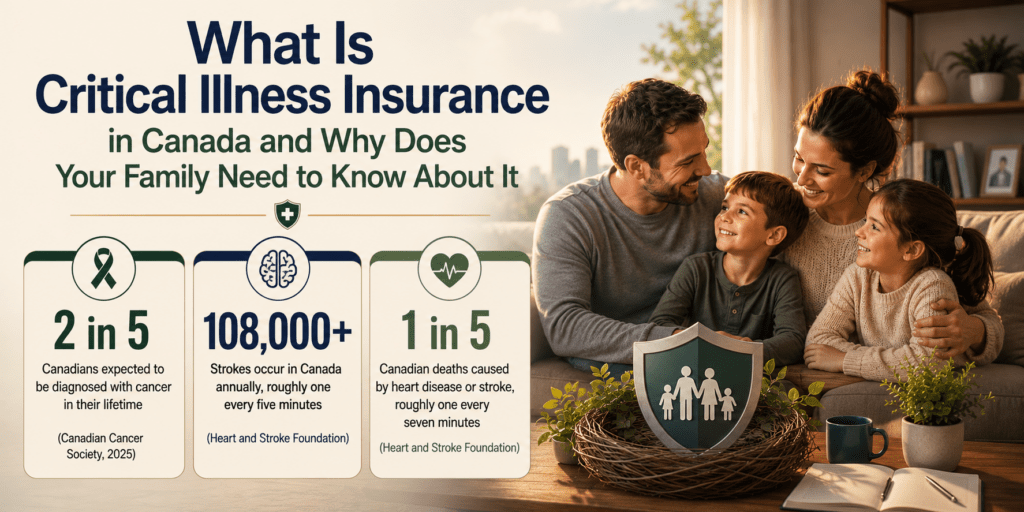
The case for critical illness insurance in Canada rests on three numbers: 2 in 5 Canadians will be diagnosed with cancer in their lifetime, over 108,000 strokes occur in Canada annually, and heart disease and stroke together cause roughly one Canadian death every seven minutes. These three conditions, cancer, heart attack, and stroke, account for the overwhelming majority of critical illness insurance claims in Canada.
These are not remote possibilities for a young Canadian family. They are the leading causes of hospitalization, disability, and death in the country, and they strike people in their 30s, 40s, and 50s at meaningful rates. According to the Heart and Stroke Foundation of Canada, over 108,000 strokes occur in Canada annually and about one in five Canadian deaths is caused by heart disease or stroke. The financial consequences arrive not just at the end of life but in the middle of it, when a mortgage is active, children are young, and both incomes in a two-income household are relied upon.
2 in 5
Canadians expected to be diagnosed with cancer in their lifetime (Canadian Cancer Society, 2025)
108,000+
Strokes occur in Canada annually, roughly one every five minutes (Heart and Stroke Foundation)
1 in 5
Canadian deaths caused by heart disease or stroke, roughly one every seven minutes (Heart and Stroke Foundation)
The survival rate for many of these conditions has improved significantly over recent decades, which is welcome progress and also precisely what makes critical illness insurance more relevant, not less. A generation ago, a serious cancer diagnosis often meant death within months. Today, many cancer survivors go through months of treatment, extended recovery periods, and significant ongoing care needs before returning to anything resembling their previous life. The Canadian Cancer Society notes that for the most commonly diagnosed cancers, five-year survival rates exceed 90% when caught at Stage 1. People are surviving illnesses that once would have been terminal, and that survival comes with a financial cost that most families are not prepared for.
The financial consequence of surviving a critical illness in Canada is not simply lost income. It is a combination of costs that no single protection product was designed to handle alone: out-of-pocket treatment costs, home care and domestic support, mortgage continuity while a partner stops working to provide care, and recovery expenses that extend long past the point disability income replacement begins.
ProtectYourNest.ca – What Is Critical Illness Insurance in Canada
How the critical illness insurance benefit actually works
A critical illness insurance claim in Canada is triggered by a formal diagnosis of a covered condition by a licensed physician, confirmed according to the policy’s specific definition of that condition. After the diagnosis, most policies require a survival period of 30 days before the lump-sum benefit is paid. Once paid, the benefit is yours unconditionally: there is no requirement to repay it, no means test, and no restriction on how it is spent.
The mechanics are simpler than most people expect. You are diagnosed with a covered condition. Your physician confirms the diagnosis in the terms your policy specifies. You survive the waiting period (almost always 30 days for most conditions). You file a claim. The insurer pays the full benefit amount as a single tax-free lump sum directly to you.
There are two important technical points worth understanding before the rest of this series goes deeper on covered conditions and policy fine print.
The survival period is not a punishment clause
The 30-day survival period exists because critical illness insurance was originally designed to fund recovery, not to duplicate the death benefit already paid by life insurance. If a policyholder were diagnosed and died within days, the CI benefit would effectively serve the same purpose as a life insurance payout, which is already covered by a separate policy. The survival period ensures the products serve distinct purposes. For most conditions and most claimants, the 30-day period is not a practical barrier.
The 90-day cancer exclusion window is separate from the survival period
Most Canadian critical illness policies include a provision that no cancer benefit will be paid if a cancer diagnosis is made within the first 90 days after the policy takes effect. This is not a survival period. It is a waiting period that applies specifically to cancer, designed to prevent someone who is already symptomatic from purchasing coverage immediately before a diagnosis. As Sun Life notes, for cancer specifically, coverage must be in effect for a certain period before the benefit applies. This distinction matters when timing a purchase decision.
What the money actually does for a Canadian family
The standard answer to “what is critical illness insurance for” is a list: medical expenses, lost income, mortgage payments, home care. That list is accurate but abstract. A scenario is more useful.
A realistic family scenario
A 38-year-old parent of two receives a breast cancer diagnosis requiring surgery, chemotherapy, and six months of active treatment. Provincial health insurance covers the hospital stays, the surgery, and the chemotherapy drugs on the provincial formulary. It does not cover the drugs not on formulary, the private nursing during recovery at home, the childcare cost when a partner takes unpaid leave to provide care, the mortgage during the months both incomes are reduced, or the home modifications needed during recovery.
Disability insurance begins paying after the elimination period ends, replacing a portion of the income lost from not working. It does not pay for any of the other costs listed above, because those are not income replacement.
A $150,000 critical illness insurance benefit, received as a lump sum shortly after diagnosis, addresses all of them at once, without the policyholder needing to account for how each dollar was spent.
This is the gap critical illness insurance fills. Disability insurance addresses the income side of the equation. Critical illness insurance addresses everything else: the costs that arrive immediately after diagnosis and that a monthly income replacement payment was never designed to cover.
According to the Canadian Cancer Society’s 2025 statistics report, the total societal cost of cancer in Canada was estimated at $37.7 billion in 2024, with as much as 20% of those costs falling directly on patients and caregivers rather than on the health system. That share includes exactly the categories above: out-of-pocket treatment costs, lost caregiver income, home care, and recovery support. Provincial health coverage handles a significant portion of the direct clinical costs. The remaining costs land on the family.
Critical illness insurance is not the same as disability insurance
Critical illness insurance and disability insurance both pay when a serious health event occurs, but they serve different purposes. Disability insurance replaces monthly income when illness or injury prevents you from working, continuing as long as the disability persists up to the benefit period. Critical illness insurance pays a single lump sum on diagnosis of a covered condition, regardless of whether the person can work, and the payment does not repeat or continue over time.
The distinction matters because many Canadians assume that having disability coverage means they are protected for a serious illness. Disability coverage addresses income continuity. It does not address the one-time and lump-sum costs a serious diagnosis creates. A cancer patient receiving disability benefits is replacing part of their income. They are not receiving money for the non-formulary drugs, the private nursing, the home care, or the partner’s lost income from taking leave to help. Those costs require a different tool.
| Feature | Critical illness insurance | Disability insurance |
|---|---|---|
| What triggers payment | Diagnosis of a covered condition | Inability to work due to illness or injury |
| How it pays | Single tax-free lump sum | Monthly benefit, ongoing |
| Employment required | No | Yes, typically tied to earned income |
| How the money can be used | Any purpose, no restrictions | Replaces lost income |
| Does it stop when you return to work | No, it has already been paid | Yes, benefit stops on return to work |
| Covers home care and out-of-pocket treatment | Yes, indirectly through lump sum | Not directly |
| Covers partner’s lost income from caregiving | Yes, indirectly through lump sum | No |
The two products are complementary, not competing. A family with both disability insurance and critical illness insurance has covered two genuinely different financial risks that a serious illness creates. A family with only disability insurance has covered income continuity but left the lump-sum costs unaddressed.
Critical illness insurance and life insurance: the third piece
Life insurance, disability insurance, and critical illness insurance each cover a distinct financial risk that a Canadian family faces. One useful way to think about them, as described by a number of Canadian advisors and carriers, is that life insurance protects your family from the financial consequences of your death, disability insurance protects your family from the financial consequences of your inability to work, and critical illness insurance protects your family from the financial consequences of surviving a serious illness.
That third category is the one most families leave unaddressed. The assumption is that surviving is the good outcome, and that surviving means things will eventually return to normal. What the assumption misses is the cost of getting from diagnosis to normal: the months of treatment, the recovery period, the gap between what provincial health coverage provides and what the family actually needs, and the financial pressure on a household that was built on two incomes when one of them stops or is reduced.
Life insurance protects a family from the financial consequences of dying. Disability insurance protects a family from the financial consequences of not being able to work. Critical illness insurance protects a family from the financial consequences of surviving. All three risks are real. All three require a different tool.
ProtectYourNest.ca – What Is Critical Illness Insurance in Canada
Who should consider critical illness insurance in Canada
Critical illness insurance in Canada is most relevant for families who rely on two incomes to cover fixed expenses, for individuals who are self-employed or who have no group benefits coverage, for anyone with a family history of cancer, heart disease, or stroke, and for parents who want to ensure a serious illness does not force a choice between treatment and financial stability.
The population for whom critical illness insurance is most immediately relevant shares one characteristic: financial fragility in the face of an unexpected large expense. A family with $500,000 in liquid savings and no mortgage can absorb the out-of-pocket costs of a cancer treatment period without a product to help. Most Canadian families in their 30s and 40s cannot. The mortgage is active. Both incomes are needed. The emergency fund covers months, not years. A serious diagnosis without the lump sum creates a forced choice between optimal treatment and financial stability that no family should have to make.
Critical illness insurance is worth evaluating if
The timing point deserves emphasis. Critical illness insurance premiums are priced based on the probability of a claim, and that probability rises with age and with health history. A 35-year-old in good health will pay meaningfully less than a 45-year-old, and may qualify for coverage that is unavailable after certain health events. As both RBC Insurance and TD Insurance note in their published guidance, purchasing a policy while young and healthy is not only less expensive but also ensures coverage exists before a health condition that might otherwise make underwriting difficult or impossible.
What is not covered and what the fine print controls
Critical illness insurance pays a lump sum, but only for the conditions listed in the policy, and only when those conditions meet the policy’s specific definition. This is not a minor technical footnote. The definitions matter significantly, and they vary between insurers and between policy tiers. A more detailed breakdown of covered conditions and the definitions that govern them appears in Article 2 of this series. The key points for this foundational article are:
- Not all cancers trigger a full benefit. Early-stage and in-situ cancers may qualify for only a partial payout under most Canadian policies, and some are excluded entirely. The policy’s cancer definition, not the word “cancer” alone, determines whether a specific diagnosis qualifies.
- Heart attack definitions can be specific. Most policies require certain objective criteria, such as elevated cardiac enzyme levels and ECG changes, to be present simultaneously. A cardiac event that does not meet all criteria may not trigger the benefit even if the treating physician uses the term “heart attack.”
- Pre-existing conditions affect both eligibility and benefit payment. A condition treated or investigated before the policy was issued may be excluded, and an undisclosed pre-existing condition may void the policy entirely.
- The 90-day cancer exclusion window means that a cancer diagnosis within the first 90 days of coverage does not trigger the benefit, regardless of how recently the policy was purchased.
These are not reasons to avoid critical illness insurance. They are reasons to understand what you are buying before you buy it, and to confirm with a licensed advisor that the specific conditions your family history makes most relevant are covered under the terms of the policy you are considering.