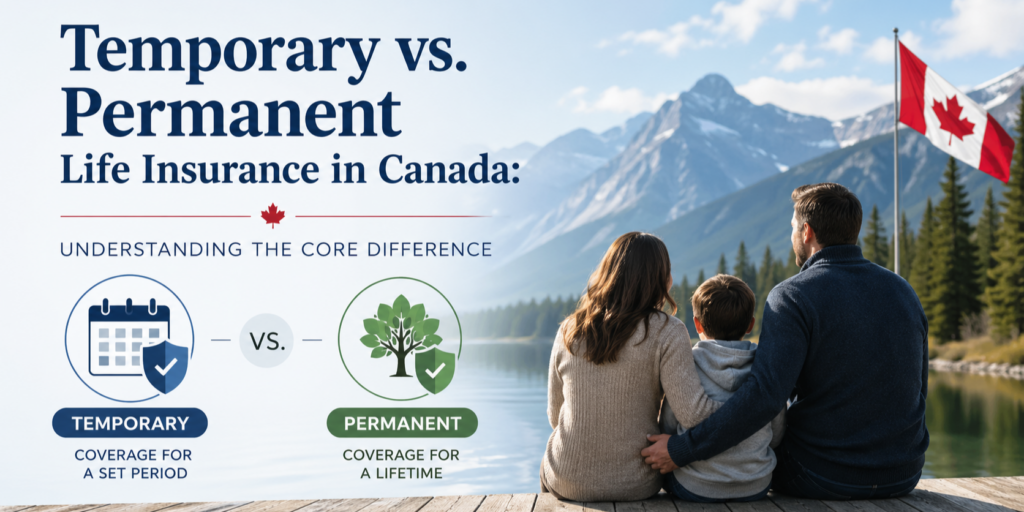
All life insurance in Canada is either temporary or permanent. Understanding the concept of temporary vs permanent life insurance helps your mentally organise every product, every conversation, and every decision you will ever make with life insurance.
If you’ve started researching life insurance, you’ve probably encountered a soup of terms: term life, whole life, universal life, participating whole life. They sound different. They are different. But they all slot into a simple two-category structure that makes the whole landscape manageable.
In the previous post, we mapped the full insurance landscape into two branches: life and health insurance on one hand, and property and casualty on the other. This post goes deeper into the life insurance category specifically, the most important distinction within it being temporary vs. permanent life insurance.
Understanding this distinction is the foundation for every life insurance decision you’ll ever make. Trust me, I am not overstating that.
Quick recap: Life insurance addresses one specific risk: the financial consequences of dying. When the life insured dies, the policy pays a tax-free benefit to the named beneficiaries.
The core distinction: temporary vs. permanent
Temporary
- Affordable: lowest premiums of any life insurance product
- Straightforward: protection only, no complexity
- Ideal for peak financial vulnerability years
- No cash value accumulation
- Premiums guaranteed fixed for the term
Permanent
- Lifetime protection — no expiry date
- Builds cash value on a tax-advantaged basis
- Higher premiums than term — often 5–10× more
- Used for estate planning and wealth transfer
- Comes in several subtypes: whole, universal, participating
The way to think about temporary vs permanent life insurance: start with the need
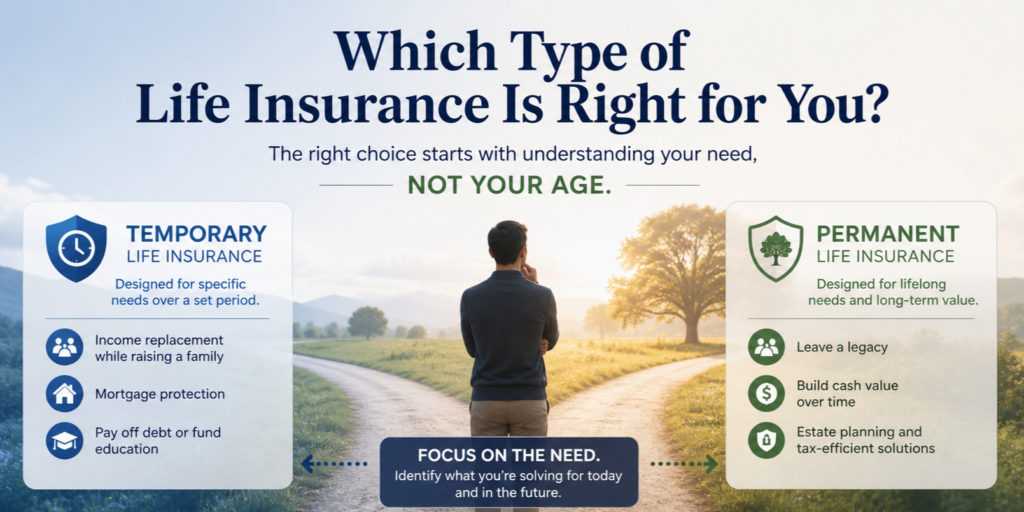
Before choosing between temporary and permanent life insurance, ask one question: is the need I’m solving for temporary or permanent? Will this go away after a while or will it stay with me no matter when I die?
The answer tells you everything.
If you are taking out a policy because you have a mortgage and do not want to leave that debt to your family if you die before it is paid off, the need is temporary. The mortgage will eventually be settled. In 20 or 25 years it will be gone. You need coverage that matches that window. Once the mortgage is paid, the need disappears. Term life insurance is built precisely for this kind of need. It covers a defined period, costs far less than permanent coverage, and ends when the need ends.
If, on the other hand, you want to ensure your estate can cover capital gains taxes on a rental property or a family cottage when you die, you need permanent insurance. Why? Because you do not know when you will die. That tax obligation will exist whether you live to 65 or 95. That need does not expire. Only permanent coverage can guarantee that a benefit will be paid regardless of when death occurs.
The framing is simple: match the type of coverage to the nature of the need. In the next post, I will be going into greater detail on which type of life policy is right for you.
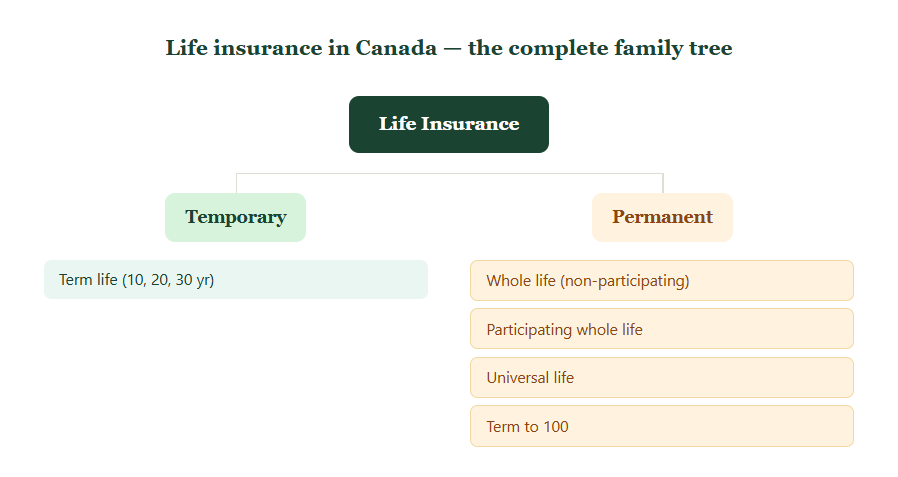
The complete life insurance taxonomy in Canada
According to Sun Life, there are four common types of life insurance in Canada. Term is the one temporary type; whole life, universal life, and participating whole life are the three main permanent types. There is one more type of permanent life insurance that is unique to the Canadian market and often overlooked: Term to 100, or T-100. Despite having Term in its name, it is actually a form of permanent insurance, as the coverage remains in place up to age 100.
Each product type explained
Term life insurance
Temporary
The bottom line: The right product for most young Canadian families. Maximum protection at minimum cost during the years you need it most.
Term to 100 (T-100) insurance
permanent
The bottom line: The simplest and most affordable permanent product available in Canada. No cash value, no dividends, no investment decisions — just a guaranteed lifetime death benefit at a predictable premium. The right tool for permanent needs on a permanent but controlled budget. Per Ratehub, T-100 premiums are cheaper than whole life while offering the same guarantee of lifetime coverage.
Whole life insurance (non-participating)
permanent
The bottom line: Simple, guaranteed, and permanent — but expensive. The cash value grows slowly and conservatively. Best as part of an estate or legacy plan.
Participating whole life insurance
permanent
The bottom line: The most sophisticated whole life product. Strong long-term value for the right buyer but the most complex and most expensive product in the category.
The four products at a glance
Term
T-100
Whole Life
Participating
Universal
| Coverage duration | 10–30 years | Lifetime | Lifetime | Lifetime | Lifetime |
| Cash value? | No | No | Yes — guaranteed | Yes + dividends | Yes — self-directed |
| Dividends? | No | No | No | Yes (not guaranteed) | No |
| Premium flexibility | Fixed | Fixed to age 100 | Fixed | Fixed | Flexible |
| Relative cost | Lowest | Mid. Lower than whole life | High | Highest | High |
| Complexity | Simple | Simplest permanent | Moderate | Complex | Most complex |
| Best life stage | Family building years | Permanent need, simple budget | Estate planning | Wealth transfer | Sophisticated investors |
A word on commission bias: Permanent life insurance products carry significantly higher commissions than term policies. PolicyMe notes this is a key factor to consider when evaluating advice. This creates an incentive that can influence recommendations. Always ask your advisor to explain specifically why a permanent product is being recommended for your situation, and what the commission structure looks like. For most young families, term life is the right answer. Not because it’s cheaper, but because it’s the right tool for the job. it locks in insurability at a cost that is affordable while there are still a lot of competing needs.