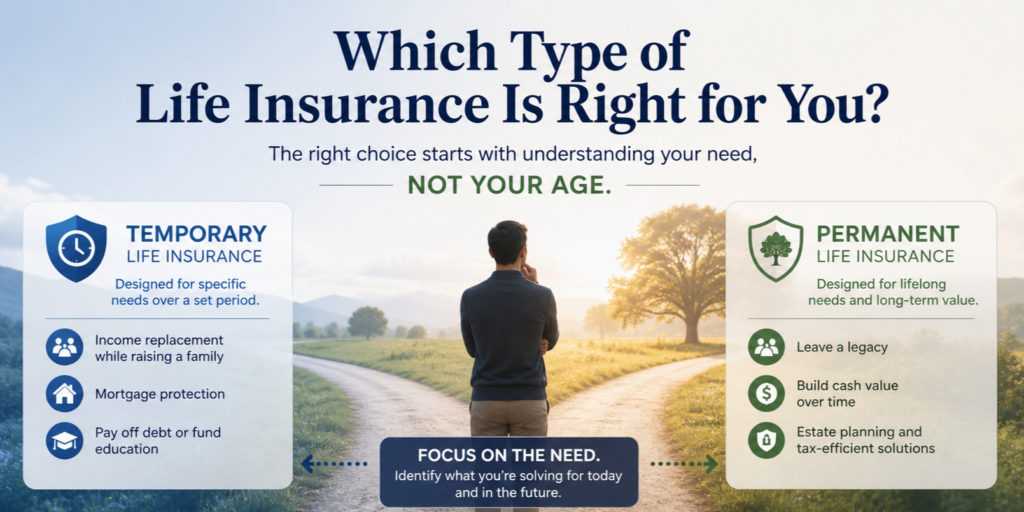
Most life insurance guides in Canada answer the question “what type of life insurance do I need” by sorting people into age brackets. “In your 20s, buy term.” “In your 40s, consider whole life.” It is tidy advice that misses the point entirely. A 28-year-old who owns a rental property and an incorporated business has permanently different insurance needs than a 28-year-old renting an apartment with no dependents. Age is a proxy. Need is the thing.
In the previous post, we established the core framework: every life insurance decision begins with one question. Is the need I am solving for temporary or permanent? This post shows you how to apply that framework to real situations, including some that most Canadians never think about until it is too late.
The main types of life insurance in Canada
Before we dive into the types of insurance you need, let’s do a quick recap of the types of life insurance policies available in Canada.
The right type is determined by one question: Is the need you are protecting against temporary or permanent? The rest of this article shows you how to apply that framework to your actual situation.
Who Needs Life Insurance in Canada?
Most Canadians need at least some life insurance if any of the following apply: someone depends financially on your income, you carry significant debt that would transfer to your family or estate, you own assets that would trigger a tax liability at death, or your absence would leave a financial gap that your savings alone could not fill.
You likely do not need life insurance if you have no dependents, no significant debt, and enough liquid assets to cover any obligations your death would create.
The honest answer is that the question is less about who needs it in general and more about what specific need you are solving. A single person with no dependents and $800,000 in liquid investments needs very little. A married 32-year-old with two children, a $650,000 mortgage, and a $300,000 business may need $1.5 million or more.
What does life insurance cover in Canada?
Life insurance in Canada pays a tax-free lump sum to your named beneficiaries when you die. It bypasses probate, arrives within weeks, and can be used for anything: mortgage payoff, income replacement, education costs, or final expenses.
How the payout works
What events trigger a payout
A life insurance policy pays out on death from any cause, illness, accident, or natural causes, with the exceptions noted below. The cause of death does not need to be related to any condition disclosed on the application, provided the policy has passed the two-year contestability period.
The two-year contestability period
Every Canadian life insurance policy includes a two-year contestability period from the issue date. If you die within this window and the insurer discovers material information was misrepresented or omitted on your application, it can void the policy and return premiums rather than pay the death benefit. After two years, the policy is incontestable for most types of misrepresentation. This is the single most important exclusion most Canadians have never read.
Common exclusions
Suicide window
Most policies exclude death by suicide for the first two years. After that, the exclusion expires and the death benefit is paid on the same basis as any other death.
War and civil unrest
Death resulting from declared or undeclared war, military action, or participation in a riot or civil disturbance is excluded in most policies.
Criminal activity
Death while the insured is actively committing a criminal act may be excluded on public policy grounds. This exclusion is applied case by case and depends on specific policy wording.
Misrepresentation
A policy can be voided if material information was omitted or falsified on the application. This applies during the contestability period for innocent misrepresentation and at any time for fraudulent misrepresentation.
What happens if you fail to disclose a pre-existing condition
Non-disclosure is the most common reason a life insurance claim is disputed in Canada. If the insurer discovers an undisclosed material condition during the contestability period, it can void the policy and return only the premiums paid. Your family receives nothing. After two years, innocent misrepresentation may result in a reduced payout rather than a full denial. However, a fraudulent misrepresentation allows the insurer to contest the policy at any time.
The guidance is simple: disclose everything. A policy issued with a rating or exclusion because of a disclosed condition is worth far more to your family than a policy voided because of something you omitted.
What Type of Life Insurance Do I Need? It Starts With These Two Questions
Before looking at any product, answer these two questions honestly.
First: Will this financial obligation disappear at some point? If yes, it is a temporary need. Term life is the right tool.
Second: Will it exist no matter when I die? If yes, it is a permanent need. Permanent coverage is the right tool.
There is a third question that is just as important, and most young Canadians ignore it until they regret it. Can I get insurance today that I might not be able to get later? The ability to get insured at all, and at what cost, changes as you age and as your health changes. Locking in coverage early is not just about saving money. It is about preserving the option to be covered at all.
Identifying a temporary need
A temporary need is any financial obligation that has a natural end date, one that will be resolved or disappear over time regardless of when you die.
Common examples
A mortgage. You borrow $600,000 to buy a home. If you die in year three, your family is left with $580,000 of debt and no income to service it. That is a devastating, solvable problem, and it is solvable with a term life policy that covers the mortgage balance for the duration of the amortization period. In 25 years, the mortgage is gone. The need expires with it.
Income replacement during active earning years. If you have young children and a partner who depends on your income, your death creates a financial hole that needs filling for a defined period, until the kids are independent, until retirement assets are accumulated, until your partner can sustain themselves independently. That window has a horizon. Term coverage matches it precisely.
Business debt during a growth phase. A business owner who has personally guaranteed a $400,000 operating line of credit has a temporary need. The debt will be paid down. The business will grow to the point where personal guarantees are no longer required. A term policy covering that liability for 10 or 15 years addresses the need cleanly and inexpensively.
Identifying a permanent need
A permanent need is any financial obligation that will exist regardless of when you die. It cannot be resolved by outliving it.
This is where most Canadians, and many advisors, underestimate the scope of the problem. Understanding permanent needs requires understanding what actually happens to your estate when you die.
What happens to your estate when you die in Canada
This is the conversation most people never have until they are sitting with an estate lawyer after a family member has passed. Understanding it changes how you think about insurance entirely.
Deemed disposition
When you die in Canada, the Income Tax Act treats you as having sold all of your capital property at fair market value at the moment of death. You did not actually sell anything, but the CRA deems that you did.
This is called deemed disposition, and it triggers capital gains tax on the accrued gains in your estate, payable by your estate before anything is distributed to your beneficiaries.
Example: The rental property
Suppose you bought a rental property in 2015 for $350,000. At your death in 2040, it is worth $900,000. The deemed disposition rule treats you as having sold it for $900,000. The capital gain is $550,000. In Canada, 50% of capital gains are included in income, so $275,000 is added to your final tax return. At a marginal rate of approximately 53% in Ontario, the tax owing on that gain is roughly $145,000.
That $145,000 must be paid. Your estate pays it. If the only asset is the property itself, your estate may need to sell it, potentially under duress and at less than market value, to satisfy the tax bill.
A permanent life insurance policy sized to cover that tax liability means the property stays in the family. The tax gets paid from the insurance proceeds. The asset transfers intact.
Permanent need: The capital gains tax obligation does not disappear when you get older. It grows as the property appreciates. A term policy that expires at 70 solves nothing if you die at 78 and the property is worth $1.4 million.
Probate
When you die, your estate typically goes through probate, the legal process by which a court validates your will and authorizes your executor to distribute your assets. In Ontario, probate fees (called the Estate Administration Tax) are currently approximately 1.5% of the total value of your estate above $50,000.
On a $2 million estate, that is roughly $29,250 in fees, paid before any distribution to beneficiaries. On a $5 million estate, it approaches $75,000.
Permanent needs in real life: two examples
Example 1: The property owner
Example 2: The business owner
Age 30
~$28
Per month
Age 45
~$75
Per month
Age 50+
~$140
Per month
The conversion privilege
Most Canadian term policies include a conversion option, the right to convert to a permanent policy without a new medical exam, up to a certain age. This is one of the most valuable features in a term policy and one of the least understood.
It means that even if your health changes dramatically, you can still access permanent coverage by converting your existing term policy. You do not get re-underwritten. Your current health is irrelevant. The conversion rate is based on your original age and health profile at the time you bought the term policy.
If you are young, healthy, and unsure whether you need permanent coverage, a convertible term policy gives you the protection of term now and the option of permanent coverage later, regardless of what happens to your health between now and then. That option has real, quantifiable value.
How to Decide What Type of Life Insurance You Need in Canada
Working out what type of life insurance you need in Canada comes down to five steps.
The five-step decision framework
The honest bottom line
When Canadians ask what type of life insurance they need, the answer is almost never about age. Need is the driver.
A healthy 27-year-old with a rental property, a corporate business, and a growing family may need both term and permanent coverage today. A healthy 52-year-old with a paid-off mortgage, no business, grown children, and a liquid investment portfolio may need very little at all.
The question is always the same: what am I protecting, and will that need still exist no matter when I die?
If the answer to the second half of that question is yes, even partly yes, and you are young and healthy today, the cost of addressing it now versus later is not a small difference. It is a fundamental one. And the ability to address it at all is not guaranteed.