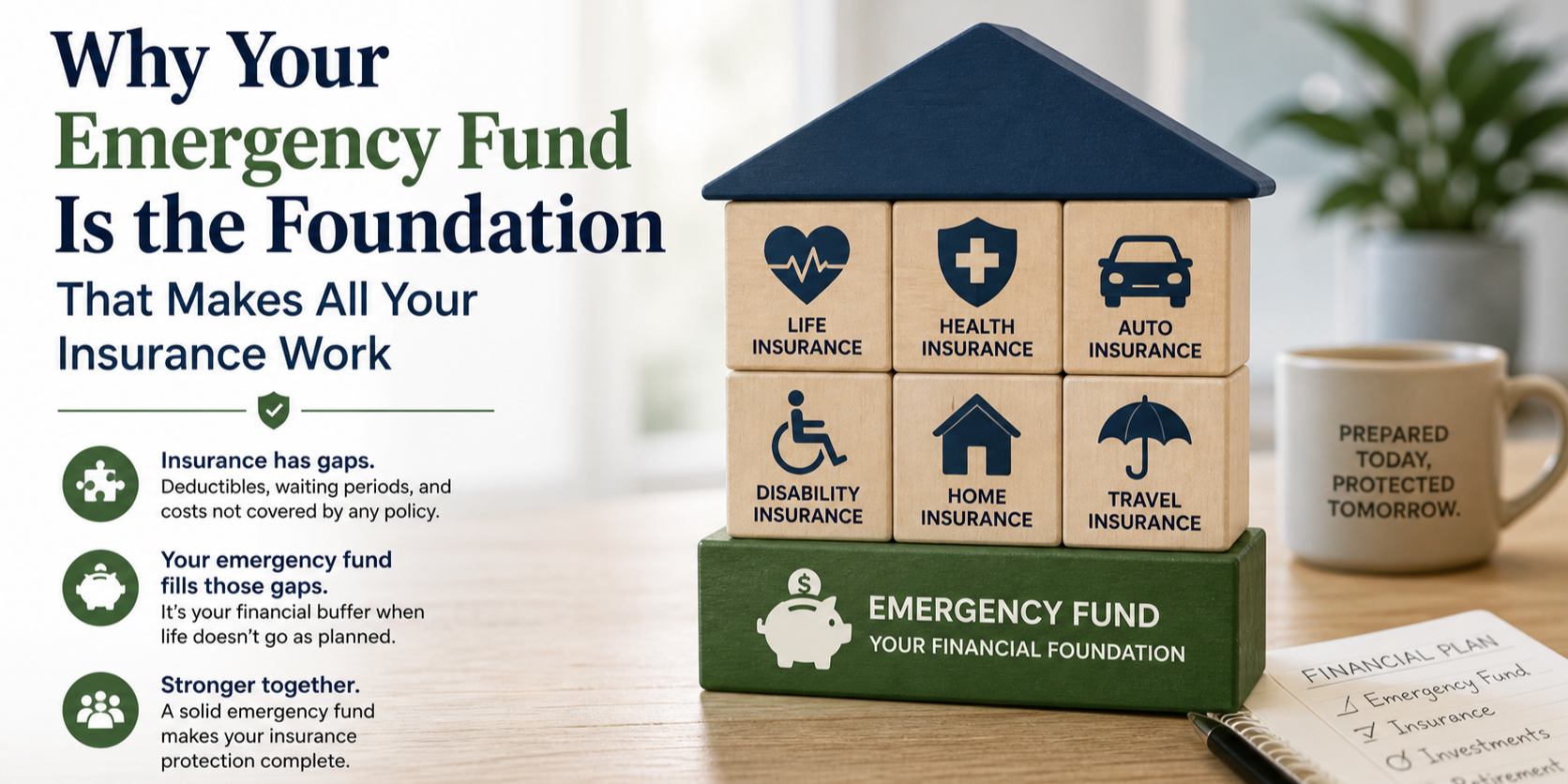
An emergency fund and insurance are not competing priorities. They are two halves of the same system. Every insurance policy you own has gaps: deductibles, waiting periods, and expenses no policy ever covers. Your emergency fund fills those gaps. Without it, even a perfectly insured family is quietly exposed. Here is how the two work together, how much you need, and how to build it.
Almost every conversation about financial protection starts with insurance. Life insurance, disability insurance, and health coverage. These are the products that dominate the discussion, and they matter enormously. However, there is a foundational layer underneath all of them, one that makes every policy you own work better, and most Canadian families either don’t have it, don’t have enough of it, or have it sitting in the wrong place.
Here is what that means in practice. You have disability insurance, good, but most disability policies have a 90-day elimination period before benefits begin. That is 90 days of zero income that you are expected to absorb on your own. Without an emergency fund, those 90 days mean missed mortgage payments, maxed credit cards, and debt that follows your family long after you’ve recovered. The insurance is in place but gap is not covered.
The same logic applies to your home insurance deductible, your dental bill, your car repair, your month of employment gap between jobs. Insurance covers the catastrophic; your emergency fund covers everything else including the space between when something goes wrong and when insurance pays. That is why the two belong together. Not one before the other. Both, in parallel, as soon as possible.
What an emergency fund actually does
An emergency fund is a pool of liquid savings, i.e. cash you can access within 24 hours, set aside exclusively for unexpected financial shocks. Not a vacation. Not a TV upgrade. Not a planned expense you didn’t budget for. Genuine emergencies: job loss, a medical cost not covered by provincial health, a car or home repair, and the financial gaps that sit between you and your insurance payout.
Think of it this way. Insurance is the long-term ambulance that handles the catastrophic events that would otherwise wipe out everything your family has built. Your emergency fund is the first aid kit. It handles everything before the ambulance arrives, everything the ambulance doesn’t cover, and everything too small to call an ambulance for in the first place. A family that has the ambulance but no first aid kit is not as protected as they think.
The gap insurance doesn’t cover but your emergency fund does
Here is the reality that most insurance conversations skip. Every insurance product has a built-in gap between the moment something goes wrong and the moment money arrives. Your emergency fund exists to fill that gap. Without it, those gaps become debt.
The most consequential gap is the disability insurance elimination period. Most individual disability policies require you to be disabled for 60, 90, or 120 days before the first benefit cheque arrives. CLHIA data shows the 90-day elimination period to be the most common. That is three months of zero replacement income, not because your coverage failed, but because that is how the product is designed. A family without an emergency fund in that scenario does not have a disability insurance problem. They have an emergency fund problem.
There is a second implication worth knowing: the longer the elimination period you can absorb, the lower your disability premium. A policyholder with a funded emergency fund can choose a 90 or 120-day elimination period instead of 30 days and the difference in premium is significant. Your savings directly reduce the cost of your insurance. Your emergency fund and your insurance product are not competing. They are designed to work together.
What insurance covers
What emergency fund covers
Long-term disability: after the waiting period
The 90–120 days before disability benefits begin
A house fire: after your deductible
Your $1,000–$2,500 home insurance deductible
Death: pays your beneficiaries, not your bills today
Mortgage and bills while your family processes a claim
Dental work: up to your annual maximum
Dental costs below your deductible and after your annual maximum
A major car accident: after your deductible
Car repair costs below your deductible
Job loss
The gap between losing a job and EI benefits starting
The disability waiting period trap: Most disability insurance policies have a 90-day elimination period before benefits start. That means if you become disabled today, your first benefit cheque arrives roughly three months from now. If you don’t have an emergency fund, you’re paying your mortgage, your groceries, and your children’s needs out of savings you may not have — or credit card debt you’ll spend years repaying.
The real cost of not having an emergency fund: a Canadian example
Scenario: Hot water heater fails in January, Toronto
No emergency fund. One credit card. Monthly payment: $200.
Replacement hot water heater (installed)
$2,200
Credit card interest rate
21.99%
Months to pay off at $200/month
13 months
Total interest paid
$427
True cost of the hot water heater without an emergency fund
$2,627
True cost with a funded emergency fund (HISA at ~4%)
$2,200
That’s one small emergency. Now imagine three of these in the same year, a car repair, a dental bill, and a household appliance dying. According to the Bank of Canada, 46% of Canadians carry an outstanding credit card balance, and 23% of those have balances at 80% or more of their limit. The emergency fund gap isn’t just inconvenient, it’s quietly expensive.
How much emergency fund do you need in Canada?
The standard guidance from financial regulators and advisors across Canada is 3–6 months of essential living expenses. But the right number for your family depends on several variables. Use this calculator to find yours.
How much emergency fund do you need?
The right target depends on your household situation. Enter your monthly essentials below — the calculator sets your target based on the stability of your income and shows you a realistic timeline to get there.
Emergency Fund Calculator
For Canadian families — values in CADYour personalised emergency fund target
The self-employed rule: If you’re self-employed, freelance, or working contract, the standard 3-month target doesn’t apply to you. You need a minimum of 6 months and many financial planners recommend 9–12 months for those without predictable income. Your emergency fund is also your income buffer in slow periods, not just a break-glass-in-case-of-emergency reserve.
Where to keep your emergency fund in Canada
Your emergency fund needs to meet two criteria that seem to be in tension: it needs to be accessible (you can get it within 24 hours) and it needs to earn some return (it shouldn’t sit in a chequing account earning nothing). Here are the right and wrong places to keep it.
Good choice
Best choice
Acceptable for a portion
Never use this
Not a substitute
Wrong account
How to build your emergency fund: a realistic plan
Building 3–6 months of expenses feels overwhelming until you break it into stages. Nobody builds a complete emergency fund overnight. Here’s how to approach it practically.
The right approach: emergency fund and insurance, built together
These two systems are not competing priorities. They are complementary. Each handles a different type of financial risk, and each makes the other work better. If you have dependents, get life insurance and disability insurance also immediately; do not wait until your emergency fund is fully built. Remember to always prioritize what matters.
The synergy in action: A family with a fully funded emergency fund can confidently choose a 90 or 120-day disability elimination period instead of 30 days and pay significantly lower premiums as a result. The CLHIA confirms this is one of the most effective ways to reduce disability insurance costs without reducing the benefit amount. Your emergency fund does not just protect you from small emergencies. It actively reduces the cost of your insurance. The two systems are designed to work together.