
In answering the question “How much life insurance do I need”, most articles about life insurance coverage will give you a formula or a rule of thumb and send you on your way. This article does something more useful: it teaches you how to think about your number, so that when life changes, and it always does, you know exactly how to recalculate.
The number that comes out of a life insurance calculation is only as good as the thinking that went into it. A family that understands why each component of their coverage exists will make better decisions when their mortgage shrinks, when a child becomes independent, when income grows, or when a business is acquired. A family that simply accepted a number from a calculator five years ago and moved on is almost certainly either over- or under-insured today.
This article walks you through the full reasoning process in seven steps. At the end, the calculator applies everything you’ve learned to your own situation. The goal is not to give you a number but it is to give you a framework you can use for the rest of your life.
Want to skip straight to your number? Use our free DIMEF life insurance Coverage Calculator to get your personalized coverage gap in under 3 minutes.
Before any formula, before any methodology, before any numbers, do this. Close your eyes and imagine your spouse or partner waking up the morning after your funeral. Not the day of. The morning after. The people are gone. The flowers are wilting. The practical reality of life without you has just begun.
What does that person face in the next 90 days?
Work through this list honestly. Each item that creates financial stress is a coverage need.
- The mortgage payment comes due. Is there enough in the account to cover it while they grieve, manage the estate, and figure out what comes next?
- The children still need to be fed, clothed, cared for, and schooled. Who pays for childcare while the surviving parent goes back to work or decides whether they can?
- The car payment, the line of credit, the credit card balances. These are all still showing up in the mail. Do those get paid or do they accumulate?
- One income has disappeared. How long can the household survive on what remains before something e.g. the house, the lifestyle, the children’s plans, has to change?
- The children’s education. Was there a plan for that? Is the plan still intact?
- The estate. Legal fees, probate costs, potential capital gains taxes on property — these arrive as bills while the family is still processing loss.
Every item on that list that creates financial hardship is a coverage need. Life insurance exists to convert those hardships into solved problems. The exercise tells you what you are solving for. The methodology tells you how much solving costs.
Not every financial obligation that death creates lasts forever. Some needs have an end date. The mortgage will eventually be paid off, the children will eventually grow up, debts get retired. Others will exist for as long as you live. The most important distinction in life insurance planning is understanding which of your needs falls into which category.
Related: This is the core concept behind the distinction between term and permanent life insurance. Read our full guide:Temporary vs. Permanent Life Insurance in Canada →
⏱ Temporary needs
- The outstanding mortgage balance. This shrinks with every payment, gone in 20–30 years
- Income replacement while children are dependent. This ends when they reach independence
- Non-mortgage debts e.g. car loans, student loans, credit lines all have payoff dates
- Children’s post-secondary education costs. A defined, time-limited expense
- Business debts or key person obligations during a company’s growth phase
∞ Permanent needs
- Capital gains tax on a rental property or family cottage. This is due whenever death occurs
- RRSP/RRIF tax liability at death. Income tax on the full registered balance
- Business succession: buy-sell obligations that exist for the life of the business
- Estate equalisation: ensuring heirs receive equivalent value regardless of asset type
- Final expenses and funeral costs. This is unavoidable regardless of when death occurs
- Lifelong charitable commitments
Temporary needs call for term life insurance i.e. coverage with an end date that matches the duration of the obligation. Permanent needs call for permanent insurance i.e. T-100, whole life, or universal life, because these obligations have no expiry. Getting this distinction right is the most important decision in the life insurance conversation, and it is the one most often skipped by simple “how much do you need?” calculators.
Here is the insight that almost no life insurance article addresses: your coverage needs are not static. Some of what you are protecting against gets smaller over time. Some of it gets larger. A coverage amount that was accurate at 35 will almost certainly be wrong at 45 in both directions at once, for different reasons.
Needs that shrink over time
- ↓Your mortgage balance declines with every payment
- ↓Non-mortgage debts are paid down or off
- ↓Children age toward financial independence
- ↓Education costs are funded and behind you
- ↓Savings and investments accumulate thus reducing the net need
- ↓Employer group life insurance adds coverage at no personal cost
Needs that grow over time
- ↑Your income increases and so does the replacement need
- ↑A rental property or cottage appreciates and capital gains liability grows
- ↑RRSP and RRIF balances accumulate and the tax bill at death grows
- ↑Business value increases and the buy-sell obligations grow with it
- ↑A new child or dependent can appear at any point
How a typical Canadian family’s coverage needs evolve over 25 years
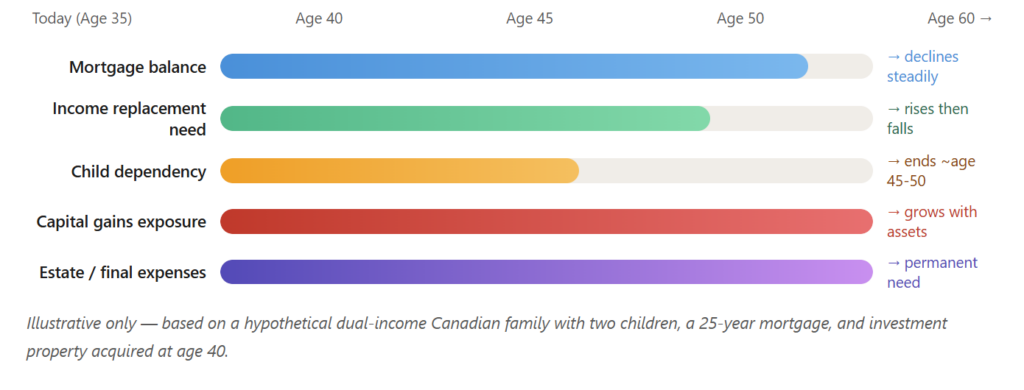
Once you understand what you are protecting and whether each need is temporary or permanent, you can use a structured methodology to translate those needs into a coverage amount. The most widely used framework in Canada is the DIME method. It is used not because it is perfect, but because it is comprehensive, logical, and easy to update as life changes. We build on it by adding one more letter, F. We call it the DIMEF method. You will see why below.
D
Why it’s in: debt that outlives you burdens your estate and your surviving family. The payout eliminates it entirely, immediately.
I
Why it’s in: your income is your family’s largest financial asset. Its sudden disappearance is the central financial catastrophe life insurance exists to prevent.
M
Why it’s in: housing security is the foundation of financial stability for a surviving family. Losing the home compounds every other consequence of loss.
E
Why it’s in: the opportunity represented by post-secondary education is one of the most significant gifts you can leave your children. Ensuring it is funded regardless of what happens to you is a reasonable and achievable goal.
F
Why it’s in: these costs arrive as bills at the worst possible time. Pre-funding them means your surviving family deals with loss, not logistics.
A worked example: Maya and David, both 38
Maya earns $95,000 per year. She and David have two children aged 6 and 9, a $520,000 outstanding mortgage, $35,000 in non-mortgage debt, and $22,000 in combined RESP savings. Here is how Maya’s coverage need is calculated:
Maya’s coverage calculation: DIME + Final Expenses
Age 38, non-smoker, $95,000 income, two children (ages 6 and 9), dual-income household
Debts
Credit card & line of credit
$18,000
Car loan
$17,000
Debts subtotal
$35,000
$95,000 × 20 years (youngest child is 6)
$1,900,000
Income Replacement Subtotal
$1,900,000
Mortgage
Outstanding balance
$520,000
Mortgage Subtotal
$520,000
Education
2 children × $101,000
$202,000
Less: existing RESP savings
($22,000)
Education Subtotal
$180,000
Final Expense
Funeral, estate, probate estimate
$20,000
Final Expense Subtotal
$20,000
Total coverage needed
$2,655,000
Less: Group life through employer (2× salary)
($190,000)
Maya’s coverage gap
$2,465,000
A number like $2,465,000 can feel large. But consider what it represents: 20 years of Maya’s income, a paid-off home, and two funded educations. A 20-year term policy for that amount for a healthy 38-year-old non-smoking woman can be obtained for approximately $100–$160/month depending on the insurer and health profile. That is the cost of removing the financial catastrophe from a family catastrophe.
Your life insurance coverage need does not exist in isolation. What you have already built, savings, group coverage, and a funded emergency fund, reduces the gap you need to close with individual insurance. And what you do with your emergency fund can directly reduce the cost of other insurance, freeing up money for life coverage.
Deduct what you already have
Before accepting the gross DIME total as your coverage need, subtract:
- Employer group life insurance: this is typically 1–2× salary. Real coverage, but portable only as long as you hold the job
- Existing personal policies: any life insurance already in force counts against the gap
- Funded RESPs: education savings already set aside reduce the education component
- Liquid savings and investments: TFSA, non-registered investments, and liquid assets your family could access. Be conservative here, don’t count RRSP assets, as withdrawals are taxable.
How your emergency fund reduces your total insurance cost
A fully funded emergency fund (3–6 months of essential expenses) directly lowers your disability insurance premium. Here is how: most disability policies offer a choice of elimination periods, 30, 60, or 90 days before benefits begin. The elimination period is the gap you must cover on your own savings. A family with no emergency fund must choose the shortest (most expensive) elimination period. A family with 3–6 months saved can confidently choose a 90-day elimination period and the premium difference is significant. Lower disability premiums free up monthly cash flow that can be directed toward life insurance. Your savings reduce your insurance cost. Read: Why Your Emergency Fund Is the Foundation That Makes All Your Insurance Work →
How extended health and dental coverage helps indirectly
This one is subtle but real. A family with solid extended health coverage, dental, prescriptions, physiotherapy, mental health, faces lower out-of-pocket health expenses in the years following a death. A surviving spouse with comprehensive health coverage needs less income replacement to maintain their household’s standard of living than one who faces full health costs out of pocket. The reduction is modest, but it is a real offset worth acknowledging in a thorough needs analysis.
One of the most powerful and least discussed techniques in life insurance planning is layering. This is where you structure multiple smaller policies with different term lengths instead of buying a single large policy. The logic is straightforward: your coverage needs are not uniform across time. They peak in the early years and decline as debts are paid and dependents grow up. A layered approach provides more coverage when you need it most and less when you need it least and the total cost is often lower than a single large policy held for the full period.
Policy 1 — $500,000 / 10-year term
Covers the period of highest vulnerability: young children, peak mortgage balance, maximum debt load. Expires when the youngest child is entering secondary school and the mortgage is substantially paid down.
Highest need years, most coverage
Policy 2 — $750,000 / 20-year term
Continues for the full 20 years of the family’s peak financial vulnerability. Covers the mortgage balance and the income replacement need through to the point where both children are independent and the mortgage is cleared.
Core coverage through family-building years
Policy 3 — $200,000 / T-100 (permanent)
Covers the permanent obligations that exist regardless of when death occurs — final expenses, potential estate taxes, a charitable bequest. Because T-100 carries no cash value component, it is the most affordable permanent coverage available in Canada.
Permanent need, permanent coverage
In the early years, this family carries $1,450,000 in combined coverage. After year 10, the first policy expires and coverage drops to $950,000 which closely matches the reduced mortgage balance and income replacement need at that stage. After year 20, coverage drops to $200,000 which is the permanent base. The family paid for exactly what they needed at each stage, and not a dollar more.
Layering adds complexity. Each policy is a separate contract with its own insurer, premium, and review cycle. A licensed life insurance advisor is the right person to help structure a layered arrangement — they can model the total cost over the coverage period against a single-policy alternative and show you the actual difference. Arrive at that conversation understanding the concept, and you will get far more from it.
The number you calculate today is accurate for your life today. It reflects your income, your mortgage balance, your debts, your children’s ages, and your savings as they stand right now. Every one of those inputs changes over time; some gradually, some overnight. A life insurance coverage amount that is not regularly reviewed is a snapshot of the life you used to have, not the one you are living.
This is Layer 6 of the six-layer Canadian family protection framework – the review habit that keeps everything else current. It is the layer that turns a good protection plan into a great one. Here are the specific events that should trigger an immediate coverage review:
A new child or dependent
Each new dependent adds an education cost component and typically extends the income replacement period.
A home purchase or refinance
A new mortgage balance changes the M component of DIME immediately. A refinance may increase it.
A significant income change
A promotion, a business launch, or a career change alters the I component up or down.
Marriage or divorce
Both change who depends on your income, who holds policy ownership, and who is named as beneficiary.
A job change
Group life coverage can disappear overnight. Personal coverage needs to fill the gap immediately.
Acquiring investment property
This creates a new permanent coverage need – the capital gains tax liability on death that did not exist before.
The annual review rule: At minimum, review your coverage once a year — a 20-minute exercise of checking whether your mortgage balance, income, family situation, and savings have changed materially since you last calculated. After any of the six trigger events above, review immediately. Your coverage today is only as good as the assumptions it was built on. When those assumptions change, the coverage needs to change with them. Read: The 6 Layers of Canadian Family Protection — and Why Layer 6 Is the One That Makes Everything Work →
Now calculate your number
You have worked through the full reasoning process. You understand what you are protecting, why each component exists, which needs are temporary and which are permanent, how your coverage need evolves over time, and how to use layering and other coverage to manage cost intelligently.
The calculator below applies everything you’ve just learned to your own numbers. Enter your details and it will generate your personalised DIME coverage calculation — including the income replacement years that match your family situation, deductions for existing coverage, and a recommended term length. The result is not a magic number. It is a starting point for a conversation — with yourself, and eventually with a licensed advisor.
Use the calculator: Now that you understand the thinking behind the numbers, visit our dedicated Life Insurance Calculator page for the full standalone version with PDF report. Enter your numbers to get your personalised coverage estimate, recommended term length, and estimated monthly premium range.