Before you compare policies or calculate coverage amounts
There is one concept worth understanding completely. Insurance is not a product. It is a principle. And once you grasp the principle, every decision that follows becomes easier. This guide goes back to first principles and covers everything a Canadian family needs to know before making any coverage decision.
Most people think of insurance as a bill they pay every month and wish they didn’t have to. That thinking is understandable but it is why so many Canadians are either underinsured, badly insured, or confused about what they actually have.
This guide goes back to first principles. What is insurance, really? How does it work? What types exist in Canada, and which ones are required by law? What do common insurance terms actually mean? And how does the right coverage change depending on where you are in life? Everything else on this site builds from here.
What is insurance at its most basic?
Insurance is a financial arrangement in which you trade a small, certain loss (your monthly premium) for protection against a large, uncertain loss (a claim event).
If that is still a little abstract, here is how it works in practice.
Imagine you and 99 of your neighbours each put $30 into a shared pot every month. That is $3,000 going into the pot monthly, or $36,000 over the year. Now imagine that two of your neighbours have a house fire this year. Repairing the damage costs $18,000 each. The pot pays for it. You contributed $360 over the year and never needed to make a claim, but if your house had been the one that caught fire, that $360 contribution would have been the best financial decision of your year.
That is insurance. You traded a small, certain loss (your $30 monthly payment) for protection against a large, uncertain one. The fire might never happen to you. But if it does, you are not facing $18,000 alone.
The insurance company is essentially the manager of the pot. They collect the premiums, calculate how many claims they are likely to pay out in a given year, and make sure the pot is always large enough to cover them. The bigger the pot, the more stable and predictable the whole system becomes. That stability is what allows an insurer to promise you $500,000 in life insurance coverage in exchange for a $35 monthly premium.
Before we continue, a few stats that may surprise you.
Prefer to watch? Here’s the video version
How insurance actually works: the risk pooling principle
Understanding why insurance is affordable (why you can pay $30 a month and have access to $500,000 in coverage) requires understanding one key concept: risk pooling.
An insurance company brings together thousands of people who all face similar risks. Everyone pays a premium. The premiums are pooled together. When any one member of the pool experiences a covered loss, the pool pays for it. The cost of one person’s catastrophe is spread across thousands of contributors.
Why the math works
No single person can predict whether they will make a claim in any given year. But an insurer can predict with reasonable accuracy how many people out of a large group will make a claim. Actuaries, the mathematicians of the insurance industry, use statistics, historical data, and risk models to price this with precision. By pooling risk across thousands of policyholders, the cost of any individual’s catastrophic loss becomes manageable for everyone in the pool.
Why your age and health affect your premium: Insurers assess how much risk you bring to the pool. A 28-year-old non-smoker in excellent health is statistically less likely to make a life insurance claim than a 55-year-old smoker, so they pay a lower premium. You are not being punished or rewarded for your lifestyle. The insurer is pricing your contribution to the pool based on your actual statistical risk profile.
The four types of financial risk insurance addresses
Insurance in Canada exists to address four broad categories of financial risk. Every insurance product you’ll ever encounter maps to one or more of these:
Life insurance answers this
Disability insurance answers this
Home & renters insurance answers this
Health insurance answers this
What insurance is mandatory in Canada?
Not all insurance is optional in Canada. Some types are required by law, others are effectively required by lenders or circumstances. Here is a clear breakdown.
Type of insurance
Required?
Details
| Auto insurance | Legally required | Mandatory in every province and territory. You cannot legally drive without at least third-party liability coverage. Minimum requirements vary by province. In Ontario, for example, driving without insurance can result in fines of $5,000 to $25,000 for a first offence. |
| Mortgage default insurance (CMHC) | Required in most cases | Required when your down payment is below 20% of the home purchase price. Regulated by the Canada Mortgage and Housing Corporation (CMHC). The premium is added to your mortgage. This insurance protects the lender, not you. |
| Workers’ compensation | Required for employers | Fixed base amount; grows over time through Most employers in Canada are required by provincial law to register with and contribute to their provincial workers’ compensation board, which provides coverage for workers injured on the job. |
| Home insurance | Required by most lenders | Not legally mandatory, but virtually all mortgage lenders require it as a condition of the mortgage. Without a mortgage, you can technically go without, though the financial risk of doing so is enormous. |
| Life insurance | Optional | No legal requirement, though some lenders may require mortgage life insurance. Whether you need it depends on whether others depend on your income. |
| Disability insurance | Optional | No legal requirement. However, the CLHIA reports that one in three Canadians will be disabled for 90 days or more at some point before retirement. Most group benefit plans include some disability coverage. |
| Health and dental insurance | Optional | Provincial health care covers basic medical services, but not dental, vision, most prescription drugs, physiotherapy, or mental health services. Supplemental health insurance is optional but widely considered essential for families. |
Key insurance terms every Canadian should understand
Insurance policies are legal contracts written in technical language. Understanding a handful of core terms before you buy a policy significantly reduces the risk of being caught off guard when you need to make a claim. Here are the eight most important terms.
How making an insurance claim works in Canada
Understanding what happens after a loss is as important as understanding what a policy covers. Many Canadians are surprised by how the claims process works because it is rarely explained before they need it. Here is what to expect. Find the step-by-step claims process below.
The two questions insurance is designed to answer
At ProtectYourNest.ca, we organize every insurance decision around two questions. They’re simple but they cut to the heart of why insurance matters for every Canadian family:
Every type of insurance you’ll encounter on this blog maps back to one of these two questions. Keep them front of mind and the entire landscape of Canadian insurance becomes dramatically clearer.
Insurance is not an expense. It is a transfer of risk. When you buy insurance, you are not spending money on something you might never use. You are transferring a catastrophic financial risk to an entity designed to absorb it and thus freeing yourself to save, invest, and live without that risk hanging over your family. The premium is the price of certainty.
Or Start Here: Canadian Family Protection: The 6 Layers of Protection Every Canadian Family Needs
Our cornerstone post. The philosophical foundation for every insurance decision you’ll ever make.
What insurance is not
Just as important as answering the question “what is insurance”, is answering the question “What is insurance not?”
Insurance is not a savings account. A standard term life policy, renters policy, or disability policy does not accumulate cash value. You pay premiums; if you make a claim, it pays out; if you don’t, the premiums served their purpose as risk transfer. Some permanent life insurance products do build cash value but even then, the primary purpose is protection, not investment.
Insurance is not a get-rich-quick mechanism. Insurance pays for losses. It is designed to return you to the financial position you were in before the loss not to profit from it.
Insurance is not something to buy when things go wrong. The entire point of insurance is to own it before anything happens. Your ability to qualify for insurance coverage and at affordable rates, also known as your insurability, depends on your health and age at the time of purchase. Waiting until you need it is often too late.
So, hopefully, the next time the question “what is insurance” comes up in conversation, you would be able to give a good explanation.
How Canadian policyholders are protected
Canada has one of the most regulated insurance industries in the world. Here is how that regulation protects you at every level.
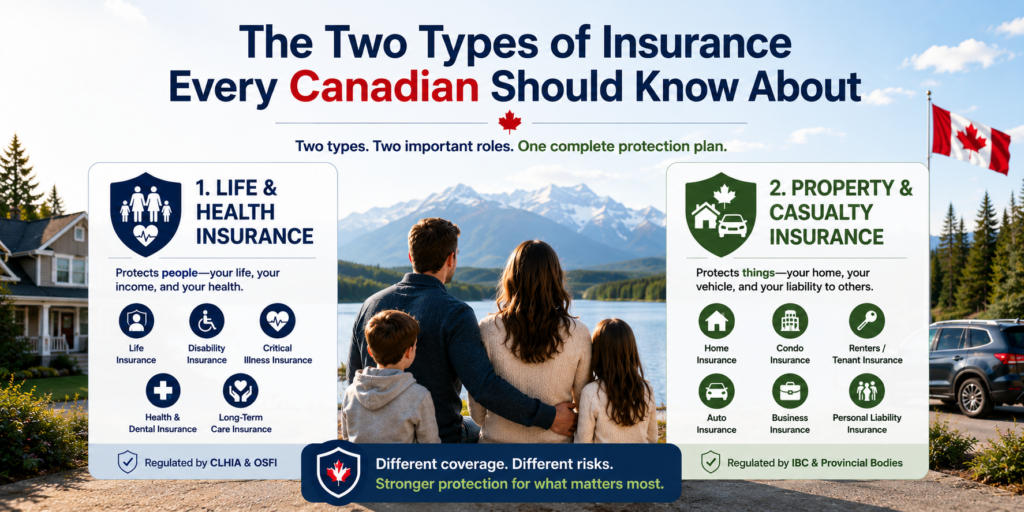
Regulatory oversight: Life and health insurance companies are regulated federally by the Office of the Superintendent of Financial Institutions (OSFI) and provincially by each province’s financial services regulator. Property and casualty insurers are primarily provincially regulated. The Insurance Bureau of Canada (IBC) and the Canadian Life and Health Insurance Association (CLHIA) set additional industry standards and consumer protection guidelines.
If your insurer becomes insolvent: Canadian policyholders have an additional layer of protection that is unique to this country and worth knowing about.
Your insolvency protection as a Canadian policyholder
This protection means that buying insurance from any licensed Canadian insurer carries a meaningful safety net. You do not need to choose between large and small insurers on the basis of insolvency risk alone. The regulatory framework is designed to protect you regardless.
What comes next
Now that you understand what insurance is and why it exists, the natural next step is understanding the full landscape; how all the different types of insurance in Canada connect, and which ones apply to your life. That’s exactly what the next post covers.
Read more: The 2 Branches of Insurance Every Canadian Should Know
A complete map of the Canadian insurance landscape; life and health insurance vs. property and casualty insurance, and where every product fits.