Participating whole life insurance is the most widely sold permanent product in Canada and the one that generates the most confusion. The word “dividends” sounds familiar, but par insurance dividends are not what most people assume they are. Understanding what they actually are, how they are calculated, and what the honest limitations are is the only basis for a sound decision about whether this product belongs in your plan.
If you have read Part 1 of this series on whole life insurance, you already understand the foundations: what permanent insurance is, how cash value accumulates, and why the relationship between permanent needs and permanent products is the framework that determines whether any permanent product makes sense for you. This article builds on that foundation with a focus on the participating account and on the dividend decisions that shape how the product performs over time. The participating account is the mechanism that makes par life different from a non-participating whole life.
This is Part 2 of a four-part series on permanent life insurance in Canada. Part 1 covers whole life insurance. Part 3 covers universal life. Part 4 covers Term to 100. Each article stands alone, but reading Part 1 first provides useful context for this one.
What participating whole life insurance actually is
Participating whole life insurance, often shortened to “par insurance” or “par life”, is a form of whole life insurance in which the policyholder participates in the financial performance of a dedicated pool of assets called the participating account. This is the defining characteristic that distinguishes it from non-participating whole life: in a par policy, your premiums do not sit in isolation. They are pooled with premiums from all other participating policyholders and managed collectively by the insurer as a long-term investment portfolio.
When the participating account performs better than the insurer’s pricing assumptions (when investment returns are stronger than expected, mortality experience is more favourable, or operating expenses are lower), the surplus can be distributed to participating policyholders in the form of annual dividends. When the account underperforms those assumptions, dividends can be reduced or eliminated entirely.
A critical distinction upfront: Par insurance dividends are not the same as dividends paid by corporations to shareholders. They are not investment returns. They are, precisely speaking, a return of excess premium, i.e. the portion of your premium that the insurer set aside for contingencies that did not materialize. This distinction matters for how you evaluate the product and for how certain dividend payments are taxed. More on both below.
How the participating account works – the full flow
The participating account is the engine of par insurance. Understanding how money moves through it is the foundation for understanding everything else; why dividends vary, how they are calculated, why the smoothing mechanism exists, and what drives the insurer’s dividend scale decisions. No platform explains this clearly to a consumer audience. Here it is.
Inside the participating account – the annual cycle
How premiums become dividends
The Dividend Scale Interest Rate (DSIR): what it is and what it isn’t
The Dividend Scale Interest Rate (DSIR) is the single number most commonly used to compare participating life insurance products across Canadian insurers. It is worth understanding precisely, because it is also the number most commonly misused in par life sales conversations.
The DSIR is the insurer’s internal estimate of the par account’s net return after investment expenses, taxes, claims, and operating costs. It is one input into the dividend calculation, but only one. Mortality experience and operating expenses are equally significant. A higher DSIR does not automatically mean higher dividends if the insurer’s mortality claims are heavier or its expense ratio is higher than that of a competitor with a lower DSIR.
Participating life insurance DSIR of major Canadian insurers, 2025/2026
For comparison only. DSIR is one component of dividend calculation, not the whole picture
Insurer
DSIR (approx.)
Par account size
Notes
| Equitable Life | 6.40% | $2.7 billion | Highest current DSIR; Canada’s largest federally regulated mutual insurer; dividends paid every year since 1936 |
| iA Financial Group | 6.35% | Not disclosed | Dividend scale maintained for 2026; pay-to-100, 10-pay, 20-pay options available |
| Manulife | 6.35% | Large | Strong long-term record; Vitality benefits integrated on select par products |
| Sun Life | 6.25% | $21.2 billion | Three par products targeting different objectives; one of Canada’s largest and most stable par accounts |
| Canada Life | 5.75% | $61.9 billion | Largest par account in Canada; ~1.4 million participating policies in force |
| RBC Insurance | 6.30% | Large | Dividend scale reviewed annually; smoothing applied to stabilise distributions for policyholders |
Sources: PolicyAdvisor 2026 dividend guide · PolicyAdvisor Equitable Life review · insurer disclosure documents. Rates are approximate and subject to change at any time. Get current rates from a licensed advisor who can compare across multiple insurers.
Don’t select a par policy based primarily on DSIR. When evaluating participating life insurance, the stability and scale of the par account, the insurer’s long-term dividend history, the mortality experience of the block, and the expense management of the participating account are all equally or more important than the current DSIR. A policy with a slightly lower DSIR from an insurer with a $61.9 billion par account and a 100-year dividend track record may outperform one with a higher current DSIR from a smaller insurer over a 30-year horizon.
The smoothing mechanism and why par dividends don’t mirror market returns
One feature of the participating account that is rarely explained but that significantly affects the experience of owning a par policy is the smoothing technique. Most Canadian par insurers deliberately do not pass the full impact of a single year’s investment returns through to dividends in that year. Instead, gains and losses are spread over multiple years.
What smoothing means for participating policyholders
The practical implication for policyholders: participating life insurance dividends are a lagging, smoothed reflection of the par account’s long-term experience. They are not a real-time measure of investment performance. This is precisely why par life insurance is positioned as a long-term wealth and estate planning tool rather than a market-linked investment product. The stability is a design feature, not a coincidence.
The five dividend options and what each one does and which one to choose
When dividends are declared, you have a choice about what happens to them. This election is one of the most consequential decisions in par life ownership. It determines whether dividends compound inside the policy, reduce your out-of-pocket costs, or are taken as income. Most par policies allow you to change your election at any time without a medical exam.
Here is an honest explanation of all five options, including the trade-offs most advisors don’t discuss.
How paid-up additions compound over time: a worked illustration
The compounding effect of PUAs is easier to understand visually. The numbers below are illustrative: based on a $500,000 base policy for a 45-year-old non-smoking female with dividends consistently directed to paid-up additions. Actual results will vary based on the insurer’s dividend scale, the policyholder’s age and health class, and the declared dividends in each year.
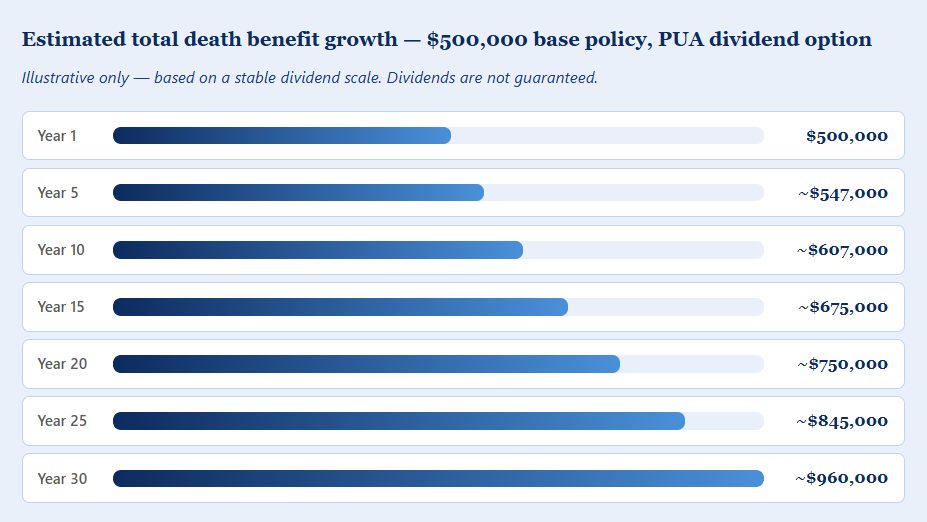
This is the estate planning case for participating life insurance made concrete: a $500,000 base policy purchased at 45 can, under a stable dividend scale, grow to nearly $1,000,000 in total death benefit by the time the policyholder is 75. That benefit is paid tax-free to named beneficiaries and bypasses probate entirely. The growth is not guaranteed, but it illustrates why par life is positioned as a multi-generational wealth transfer tool rather than just an insurance contract.
Illustration risk: the most important thing nobody tells you before you buy
The most important consumer warning in participating life insurance
The policy illustration you receive before buying is not a guarantee. It is a projection, and projections can be wrong.
When an advisor presents a participating life insurance policy, they will typically show you an illustration. This is a multi-decade projection of how the policy’s cash value and death benefit will grow over time. That illustration is generated using the current dividend scale. If dividends in future years match the current scale, the illustration’s numbers will approximately materialize. If dividends fall below the current scale, and they can, and they have, the illustrated values will not be reached.
The historical context: Canada’s par insurance dividend scales in the 1980s reflected the high-interest-rate environment of that era. As interest rates declined through the 1990s and 2000s, dividend scales followed, and policyholders who purchased in the 1980s based on illustrated projections received substantially lower dividends than their illustrations suggested. The par account continued to perform and dividends continued to be paid, but at significantly reduced rates. Policies designed around a premium offset at a high dividend scale required out-of-pocket premium payments when dividends fell short. This is not a flaw in the product. It is the inevitable consequence of a non-guaranteed mechanism. But it is essential consumer knowledge before any purchase.
How to evaluate an illustration responsibly
Ask your advisor to show you three scenarios, not just the one based on the current dividend scale. The three scenarios are:
- Base scenario: current dividend scale, unchanged. This is what the illustration typically shows.
- Reduced dividend scenario: typically 1–2% below the current scale. This stress-tests premium offset sustainability and long-term death benefit growth.
- Zero dividend scenario: no dividends at all. What are the guaranteed values only, stripped of all dividend projections? This is the policy’s worst-case floor.
A well-designed par policy should still serve its core purpose in the reduced-dividend scenario: providing permanent coverage and funding the estate obligation it was designed for. If the policy only works under the base scenario, the design is fragile and the purchase should be reconsidered or restructured.
How participating life insurance dividends are taxed in Canada
The tax treatment of par life dividends is not uniform. It depends on which dividend option you have elected and whether cumulative dividends have exceeded the policy’s Adjusted Cost Basis (ACB). This is an area where confusion is common and the cost of misunderstanding can be significant.
Tax treatment by dividend option
Under Canada Revenue Agency rules for exempt life insurance policies
Dividend option
Tax treatment
| Paid-up additions | No immediate tax event. This is an internal policy transaction, not a disposition. ACB is adjusted accordingly. |
| Premium reduction / offset | Generally treated as a premium payment with no immediate tax event in most structures. |
| Accumulated at interest | Interest earned on accumulated dividends is taxable income in the year earned, even if not withdrawn. |
| Cash payment within ACB | Not taxable if cumulative dividends do not exceed the policy’s ACB. Reduces ACB by the amount received. |
| Cash payment exceeding ACB | Amount exceeding ACB is a taxable policy gain, included in income in the year received. Taxed as regular income, not capital gains. |
| Death benefit to named beneficiary | 100% tax-free. Bypasses the estate and probate in most provinces. |
Source: Canada Revenue Agency rules for exempt life insurance policies under the Income Tax Act. The AMF notes that cash dividends may be taxable and recommends consulting a representative before electing this option. Tax treatment is subject to change. Consult a qualified tax advisor before making dividend option elections if tax impact is a consideration.
Premium offset: when par life stops costing you money
Premium offset is one of the most appealing long-term features of participating life insurance. It is the point at which accumulated dividends and PUAs are sufficient to cover the ongoing cost of the base policy. At that point you stop paying premiums out of pocket while coverage continues.
How premium offset works: the typical progression
Years 1–15 (typical): You pay premiums out of pocket. Dividends are directed to paid-up additions, building coverage and cash value simultaneously.
Years 15–20 (approximate threshold): Accumulated dividends and PUAs may reach a level sufficient to fund future premiums. Your advisor models whether offset is sustainable based on the current dividend scale.
Premium offset begins: You elect to redirect dividends toward premium payments rather than more PUAs. Coverage continues in full. No more out-of-pocket premium payments, provided dividends hold.
The ongoing risk: If the dividend scale decreases and dividends fall below the premium amount required, offset is suspended and out-of-pocket payments must resume. This is why stress-testing the offset plan against reduced-dividend scenarios is essential before relying on it.
Who participating life insurance genuinely suits, and who it doesn’t
Participating life insurance may be right for you if:
Participating life insurance is probably not right for you if:
Five questions to ask when selecting a participating life insurer
Choosing a par life policy is a 30-to-40-year decision. The insurer you select will manage your participating account through multiple market cycles, interest rate environments, and mortality changes. The five questions below matter more than any single rate comparison. Each one goes beyond the current DSIR.